A dehumidifier can drain into a floor drain by gravity if the hose runs continuously downhill and ends above the drain opening. This guide explains the air-gap setup, common mistakes, and practical troubleshooting steps.
Gravity drain into a floor drain with an air gap
To gravity-drain a dehumidifier into a floor drain, connect a compatible hose to the unit’s continuous-drain outlet, keep the hose running downhill, and position its open end above the floor drain. Do not seal the hose into the drain or push it below the drain opening. That open space is the air gap, which helps prevent contaminated drain water from flowing backward into the dehumidifier.
Check the dehumidifier manual before starting. Some models require a specific hose size, adapter, or drain connection, and some do not support continuous gravity drainage.
How the air-gap setup works
A gravity drain has no pump. Water must flow from the dehumidifier to the drain using elevation and a clear downhill path.
For reliable drainage:
The dehumidifier’s drain outlet must be higher than the floor drain.
The hose should run continuously downhill with no high spots.
The hose end should remain above the drain opening.
The hose should not be sealed, glued, or tightly inserted into the drain.
The drain must be open and able to accept water.
The air gap is the visible space between the hose outlet and the floor drain or drain grate. It should be large enough to prevent contact with standing drain water, but the hose should still be positioned so water cannot splash onto nearby electrical equipment or flooring.
Product prices and availability are accurate as of the date/time indicated and are subject to change. Any price and availability information displayed on Amazon.com at the time of purchase will apply to the purchase of this product.
Setup steps
1. Confirm the dehumidifier connection
Unplug the unit and locate the continuous-drain outlet. Remove any factory plug or cap only as directed by the manufacturer. Confirm the required hose diameter and whether an adapter is needed.
Do not remove a drain plug that the manual says must remain installed during normal bucket operation.
2. Route the hose downhill
Place the dehumidifier close enough to the floor drain that the hose can slope downward for its entire length. Avoid:
Loops that rise above the drain outlet
Kinks or crushed sections
Sharp bends near the connection
Long runs that pass behind furniture and sag upward
Sections that lie in standing water
If the unit must sit lower than the drain, gravity drainage may not work. A condensate pump may be needed instead.
3. Secure the hose connection
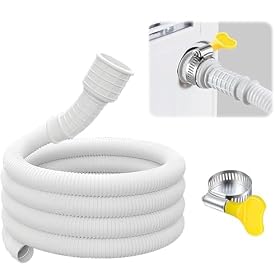
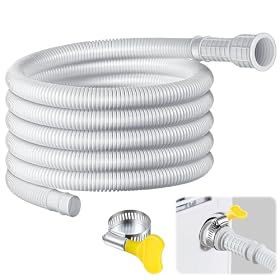
Push the hose fully onto the drain fitting or adapter. Use the manufacturer-specified clamp if one is required. The connection should be snug but should not damage or deform the plastic fitting.
4. Position the air gap
Place the open hose end above the floor drain grate or opening. Keep it from touching the drain water, and secure it so it cannot move, curl upward, or fall onto the floor.
Do not tape the hose airtight to the drain. Do not route it into a sealed standpipe unless the installation method specifically provides the required backflow protection and complies with local plumbing rules.
5. Test the installation
Restore power and run the dehumidifier. After it has collected water, check that water exits the hose and enters the floor drain without spilling. Inspect the hose connection and the floor around the unit.
If the drain does not flow, turn the unit off and unplug it before changing the hose position.
Product prices and availability are accurate as of the date/time indicated and are subject to change. Any price and availability information displayed on Amazon.com at the time of purchase will apply to the purchase of this product.
If the dehumidifier is not draining by gravity
Check the likely physical causes in this order.
Check the filter and airflow
A heavily clogged air filter can reduce dehumidifier performance and may make it appear that the drain is not working because little water is being collected. Clean or replace the filter according to the manual, then allow the unit time to produce condensate.
Check the hose for a clog or kink
Disconnect the hose if the manual permits it. Look through the hose, feel for crushed sections, and check both ends for debris or dried residue. Flush or replace the hose only in a way that will not damage the unit or introduce water into its electrical components.
Check for leaks at the connection
Water around the dehumidifier may indicate a loose hose, a missing adapter, a damaged drain fitting, or a hose that does not match the outlet size. A clamp cannot correct an incompatible connection; use the specified hose or adapter instead.
Check the slope and air gap
Make sure every section of hose slopes downward. A single raised section can trap water and stop gravity flow. Also confirm that the hose end is not submerged, blocked against the grate, or positioned so tightly that air cannot enter around the discharge point.
Check the setup and drain outlet
Verify that continuous drain mode is configured as described in the manual. Some units need a drain plug removed, while others require a plug or internal fitting to be installed in a particular position.
Pour a small amount of water into the floor drain to confirm that it accepts water freely. Do not pour water into the dehumidifier itself.
Check the bucket or full-tank condition
Some dehumidifiers stop operating when the collection bucket is full, even when a hose is attached. Make sure the bucket is seated correctly and that any full-tank indicator has cleared. A unit may also stop if its safety switch detects that the bucket is not installed properly.
Consider the unit or electrical system last
If the dehumidifier does not run, repeatedly shuts off, trips a breaker, smells hot, or shows an electrical fault, unplug it and stop troubleshooting internally. Do not bypass a float switch or open the sealed electrical system. Follow the manufacturer’s service guidance or contact a qualified appliance technician.
Product prices and availability are accurate as of the date/time indicated and are subject to change. Any price and availability information displayed on Amazon.com at the time of purchase will apply to the purchase of this product.
When a gravity drain is not the right solution
Use a condensate pump when the floor drain is higher than the dehumidifier, the hose must travel upward, or the required downhill route is impractical. A pump should be selected for the dehumidifier’s condensate output and installed according to both manufacturers’ instructions.
Replace the drain hose when it is brittle, flattened, cracked, permanently kinked, or too short to maintain a continuous slope. Replace or service the dehumidifier when it has a confirmed internal drain fault, persistent electrical problems, or repair costs that no longer make sense for the unit’s age and condition.
For installations near outlets, extension cords, finished flooring, or other electrical equipment, keep water paths controlled and follow local electrical and plumbing requirements. When the correct air-gap arrangement is unclear, ask a qualified professional rather than sealing the hose into the drain as a workaround.
FAQ
What is an air gap on a dehumidifier drain hose?
An air gap is the open space between the hose outlet and the floor drain. The hose ends above the drain rather than being sealed into or submerged in it, helping reduce the chance of drain water flowing backward into the dehumidifier.
Does a dehumidifier drain hose need to slope downhill?
Yes. Gravity drainage requires a continuous downhill path from the dehumidifier outlet to the floor drain. High spots, loops, kinks, or an uphill section can stop or slow the flow.
Can I put the dehumidifier hose directly into the floor drain?
The hose can discharge into the floor drain, but it should not be sealed into the opening or submerged. Leave an air gap and follow the dehumidifier manufacturer’s instructions and applicable plumbing requirements.
Why does my dehumidifier still fill the bucket when the hose is attached?
Common causes include a clogged or kinked hose, an incorrect hose connection, a missing or incorrectly positioned drain plug, an uphill section, a blocked floor drain, or a unit that does not support continuous gravity drainage.