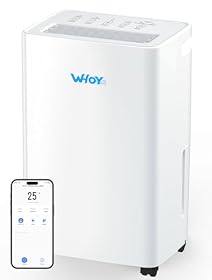
A 50-pint dehumidifier removes moisture faster and is usually the better choice for very damp basements, larger spaces, or persistent humidity. A 30-pint model can be the better fit for moderately damp rooms, smaller areas, and lower operating cost or noise.
What do you need help with?
Open an answer, or tell us what we should cover next.
Answered in this guide
Choose a dehumidifier capacity for a basement
Choose a 30-pint model for smaller or moderately damp areas, or a 50-pint model for larger, persistently damp spaces. The decision should also account for measured humidity, drainage, temperature, noise, and operating cost.
A 50-pint unit removes moisture faster and suits larger or wetter areas, while a 30-pint unit can work well in smaller, moderately damp rooms and may offer lower noise or operating cost.
The pint rating is the amount of water a dehumidifier can remove in 24 hours under specified test conditions. It indicates moisture-removal capacity, but real-world performance also depends on temperature, humidity, airflow, and the space.
Use a humidity setting that controls excess moisture without running the unit unnecessarily. The appropriate target depends on the space and conditions, so adjust it based on measured indoor humidity and signs of dampness.
Consider whether you will empty the bucket or use a hose for continuous drainage. A unit with suitable drainage can be more practical for a basement that produces water regularly or needs extended unattended operation.
Request a topic and help us choose what to build next.
Calculate the exact dehumidifier size for a room
Fix water entering a basement before using a dehumidifier
Install a permanent condensate drain system
Requests help us prioritize the next guide. No email required.
One anonymous request per topic.
A 50-pint dehumidifier is generally the better choice for a very damp basement, a larger area, or a space where humidity returns quickly. A 30-pint dehumidifier is often enough for a smaller room or moderate moisture problem. The right choice depends on actual humidity, temperature, room layout, drainage, and how quickly the space becomes damp—not floor area alone.
What the pint rating means
The pint rating describes how much water a dehumidifier can remove over a 24-hour period under a specified test condition. It does not mean the unit will always collect exactly 30 or 50 pints per day in a home.
Actual water removal is affected by:
Room temperature
Starting and target relative humidity
How often doors and windows open
Ground moisture and basement construction
Clothes drying, showers, cooking, or other moisture sources
Whether the unit has enough open space around it
A cooler basement may produce less water collection than the published rating because compressor dehumidifiers generally remove moisture less effectively as temperatures fall.
30 pint versus 50 pint: the practical difference
Consideration
30-pint dehumidifier
50-pint dehumidifier
Best general use
Small to medium rooms with moderate dampness
Larger or persistently damp areas
Moisture removal
Lower
Higher
Recovery after a humid event
Slower
Faster
Likely physical size
Often smaller, but varies by model
Often larger, but varies by model
Drainage demand
Lower
Higher
Potential noise and power use
May be lower, depending on design
May be higher, depending on design
Best reason to choose it
Adequate capacity without oversizing
More capacity for heavy moisture loads
These are general tendencies, not guarantees. Check the individual unit's noise, energy, operating-temperature, and drainage specifications before buying.
Product prices and availability are accurate as of the date/time indicated and are subject to change. Any price and availability information displayed on Amazon.com at the time of purchase will apply to the purchase of this product.
Choose a 30-pint dehumidifier when
A 30-pint model is usually a reasonable starting point when:
The room is only moderately damp.
You are treating a bedroom, office, laundry room, or smaller basement area.
Relative humidity is elevated but not consistently near saturation.
There are no obvious leaks, flooding problems, or major condensation sources.
The unit can run regularly and drain conveniently.
Lower size, noise, or electricity use is more important than rapid moisture removal.
A 30-pint unit may also work well in a larger finished basement if the space is relatively dry, open, and well sealed. However, an open floor plan with several connected rooms can behave like a larger moisture load than its main room suggests.
50-pint option for larger or persistently damp spaces
Product prices and availability are accurate as of the date/time indicated and are subject to change. Any price and availability information displayed on Amazon.com at the time of purchase will apply to the purchase of this product.
Choose a 50-pint dehumidifier when
A 50-pint model is generally the safer choice when:
The basement feels clammy or smells musty.
Humidity remains high after several hours of dehumidifier operation.
The space is large, open, or connected to other damp areas.
Moisture returns quickly whenever the unit shuts off.
You need faster recovery after rain, laundry, or a humid-weather event.
You are trying to control moisture in a basement with cool floors, foundation walls, or limited ventilation.
A larger unit does not fix active water intrusion. If water is entering through walls, floors, plumbing, or a roof, correct that source first. A dehumidifier can reduce airborne humidity, but it cannot replace waterproofing or leak repair.
Product prices and availability are accurate as of the date/time indicated and are subject to change. Any price and availability information displayed on Amazon.com at the time of purchase will apply to the purchase of this product.
Is a 50-pint dehumidifier better than a 30-pint model?
Not automatically. A 50-pint unit has more moisture-removal capacity, but the best choice is the smallest unit that can reliably maintain your target humidity under your actual conditions.
A 50-pint unit may be worth choosing if a 30-pint unit would need to run almost continuously. More capacity can reduce recovery time and help the room reach its humidity target during wet weather. On the other hand, a larger unit may cost more, take up more space, or create more noise depending on its design.
Do not choose a smaller model solely because it is cheaper if the space is persistently damp. A unit that cannot keep up may run for long periods without solving the humidity problem.
Product prices and availability are accurate as of the date/time indicated and are subject to change. Any price and availability information displayed on Amazon.com at the time of purchase will apply to the purchase of this product.
What humidity setting should you use?
Many homes aim for indoor relative humidity around 30% to 50%, but the appropriate setting depends on comfort, condensation, climate, and the building. In a basement, keeping humidity below the level that causes musty odors, visible condensation, or mold growth is usually more important than chasing the lowest possible reading.
Use a separate hygrometer if you want to compare humidity in different parts of the room. The reading on the dehumidifier may not represent the humidity near a cold exterior wall, behind furniture, or in an adjacent room.
Drainage matters as much as pint capacity
A dehumidifier can collect a substantial amount of water, especially in a damp basement. Emptying the bucket manually may be inconvenient. Before buying, check whether the model supports:
A hose connection that fits your intended drain location
A gravity drain needs a continuous downward slope. If the drain is higher than the dehumidifier or far away, a condensate pump may be necessary. Follow the manufacturer's instructions and keep electrical connections away from standing water.
Efficiency, noise, and low-temperature operation
Capacity is only one part of the comparison. Check the following specifications:
Energy use
Compare the unit's published energy information rather than assuming a 30-pint model will always cost less to operate. A larger model may remove moisture faster, while a smaller model may run longer. Actual cost depends on runtime, humidity, temperature, and electricity rates.
Noise
If the unit will operate near a bedroom, office, or living space, compare the published sound rating when available. Compressor dehumidifiers also produce vibration, so placement on a stable, level surface matters.
Operating temperature
Basements can be cooler than the rest of a home. Confirm the manufacturer's stated operating-temperature range. If the unit is used in a cold space, look for features specifically intended for low-temperature operation, such as automatic defrost. Never assume a model designed for warm rooms will work effectively in an unheated basement.
Airflow and clearance
Leave the clearance specified by the manufacturer around the air intake and exhaust. Blocking airflow with a wall, curtain, storage box, or furniture can reduce performance and cause the unit to run longer.
How to decide between 30 and 50 pints
Use this quick decision process:
Measure humidity. Check the room with a hygrometer at different times of day.
Look for water sources. Repair leaks, seepage, plumbing problems, and excessive condensation before sizing the appliance.
Consider the whole moisture load. Include connected rooms, laundry, showers, poor ventilation, and outdoor air entering through open windows.
Choose 30 pints for moderate dampness. This is more reasonable when the room is smaller, the moisture load is limited, and regular operation is acceptable.
Choose 50 pints for heavy or persistent dampness. More capacity is useful when humidity rises quickly or the area is large and open.
Plan drainage before installation. A continuous hose or condensate pump may matter more than a small difference in rated capacity.
Review temperature and noise specifications. These can determine whether the unit works well in the intended location.
The unit is placed in a small enclosed area with blocked airflow.
The bucket is full and the appliance has stopped.
The filter is dirty.
The room is too cold for the model's operating range.
The space is much larger or more open than the unit can reasonably serve.
Humidity is coming from an unvented dryer, plumbing leak, or persistent outdoor-air exchange.
If the unit runs continuously and humidity stays high after you address these conditions, a higher-capacity unit, a second unit for a separate zone, or professional moisture control may be appropriate. If the appliance trips breakers, has damaged wiring, smells burnt, or makes unusual electrical noises, unplug it if safe and consult the manufacturer or a qualified appliance technician.
Bottom line
Choose a 30-pint dehumidifier for a smaller or moderately damp space where the unit can maintain the desired humidity without excessive runtime. Choose a 50-pint dehumidifier for a larger, cooler, or persistently damp basement where faster moisture removal and more capacity are important. Before deciding, prioritize the moisture source, operating temperature, drainage method, clearance, and published energy and noise specifications.
FAQ
Can a 30-pint dehumidifier handle a basement?
Yes, if the basement is relatively small or only moderately damp and the unit can maintain the desired humidity. A larger or persistently damp basement may need a 50-pint unit, a second unit, or moisture-source repairs.
Does a 50-pint dehumidifier use more electricity than a 30-pint model?
It may, but not necessarily by the amount you would expect. Energy use depends on the model, runtime, humidity, and temperature. Compare published energy information and consider how long each unit must run to control the space.
Will a larger dehumidifier remove moisture faster?
Usually, a higher-capacity unit can remove moisture faster under comparable conditions. Actual performance depends on room temperature, airflow, humidity, and whether the unit is correctly placed.
Is a 50-pint dehumidifier too large for a small room?
Not necessarily, but it may be unnecessary if a 30-pint unit can maintain the target humidity. Compare physical size, noise, energy information, and control features rather than choosing by pint rating alone.
Do I need a drain hose for a 50-pint dehumidifier?
Not always, but a higher-capacity unit can collect water quickly. A continuous drain hose is useful when a suitable gravity drain is nearby; a condensate pump may be needed when the drain is higher than the appliance.