Two smaller dehumidifiers can improve room-by-room control, but one 70-pint unit is usually simpler for a connected basement or large open area. Compare airflow, placement, drainage, operating cost, and the unit’s pint rating before deciding.
What do you need help with?
Open an answer, or tell us what we should cover next.
Answered in this guide
Choose a dehumidifier setup for a basement
Use one 70-pint unit for a connected basement or large open area when simplicity matters. Choose two smaller units when separate rooms or wet zones need more targeted control.
Compare the real capacity of two units with one 70-pint unit
Two smaller dehumidifiers do not automatically provide the same practical capacity as one 70-pint unit. Pint ratings depend on test conditions, temperature, humidity, and newer efficiency standards.
Compare the operating cost of one versus two dehumidifiers
Two units are not automatically cheaper to run. Compare how much water each setup removes, along with its energy factor or integrated energy factor and expected operating conditions.
Compare drainage and placement tradeoffs between setups
A single unit can simplify drainage and placement, while two units may control separate rooms better. Continuous drainage is usually more practical than emptying buckets in a persistently damp basement.
Request a topic and help us choose what to build next.
Calculate the right pint capacity for a specific basement
Install a continuous drain for a basement dehumidifier
Fix a dehumidifier that keeps stopping or leaves the basement damp
Choose between standard and thermoelectric dehumidifiers
Requests help us prioritize the next guide. No email required.
One anonymous request per topic.
A single 70-pint dehumidifier is usually the simpler choice for one connected basement or large open area, while two smaller units can work better when moisture is spread across separate rooms. Do not compare pint numbers alone: a pair of smaller machines may have a higher combined rated capacity, but they also require two power outlets, two filters, two drainage setups, and more floor space.
Start with the layout, not the pint total
The most important question is whether air can move freely between the areas that need drying.
Choose one larger dehumidifier when:
The basement or floor is mostly open.
Doorways and stairwells allow reasonable airflow.
You can place the unit near a central location and a suitable drain.
You want one control panel, filter, bucket, and maintenance schedule.
Consider two smaller dehumidifiers when:
Walls, doors, or separate floors block airflow.
One area is much damper than the others.
A single unit cannot lower humidity in a distant room.
You need independent humidity settings or schedules.
Carrying one smaller machine between spaces would be inconvenient.
A dehumidifier dries the air that reaches its intake. A large capacity rating does not guarantee even humidity in rooms that are physically separated.
Capacity: why two units do not equal one simple number
Dehumidifier capacity is normally stated in pints removed per day under a specified test condition. The rating depends on temperature and humidity, and newer efficiency standards may use different test conditions than older product listings.
A “70-pint” listing may refer to an older rating convention. Some newer units with lower labeled capacities are intended to replace older 70-pint-class products. Compare the current standard, room-size guidance, and energy information rather than assuming that every pint rating is directly equivalent.
Two smaller units can have a combined rated capacity above or below 70 pints, but the real result depends on:
How much damp air reaches each machine.
Whether both units can operate continuously.
Basement temperature.
Air leakage and moisture entering from outside.
Laundry, showers, plumbing leaks, or groundwater problems.
The humidity setting and defrost behavior.
If the space is open and the moisture load is high, one large unit may provide more useful airflow and simpler control. If moisture is divided among rooms, two strategically placed units may remove more water from the problem areas even when their combined rating is similar.
Product prices and availability are accurate as of the date/time indicated and are subject to change. Any price and availability information displayed on Amazon.com at the time of purchase will apply to the purchase of this product.
One 70-pint dehumidifier: strengths and limitations
Advantages
One machine is easier to place, clean, monitor, and maintain.
There is only one filter and one bucket or drain connection.
One continuous-drain setup can be simpler than managing two.
A larger unit may move more air through an open basement.
There is less equipment occupying floor space.
Limitations
It may not dry closed rooms effectively.
A central location may be far from the dampest area.
If it fails, the entire area loses dehumidification.
A large compressor and fan may be more noticeable in a small living space.
One unit may require a longer drain hose or a condensate pump if gravity drainage is unavailable.
Do not place the unit tightly against a wall, behind stored items, or in a cramped closet unless the manufacturer specifically permits it. Restricted intake or exhaust airflow reduces performance and can cause overheating or nuisance shutdowns.
Product prices and availability are accurate as of the date/time indicated and are subject to change. Any price and availability information displayed on Amazon.com at the time of purchase will apply to the purchase of this product.
Two smaller dehumidifiers: strengths and limitations
Advantages
Each unit can serve a separate room or zone.
You can target the wettest areas directly.
One unit can continue operating if the other needs cleaning or repair.
Smaller machines may be easier to move up stairs or between rooms.
Two separate controls can help when rooms have different humidity needs.
Limitations
You must clean two filters and maintain two condensate systems.
Two bucket-style units may need frequent emptying.
Continuous drainage can require two hoses, two floor drains, or two condensate pumps.
Two compressors and fans can produce more combined noise and heat.
They use two outlets and may increase the chance of an overloaded circuit if other equipment shares it.
A pair can cost more to replace over time because there are twice as many machines.
Do not use a power strip or extension cord unless the manufacturer explicitly allows it and the cord is properly rated. Dehumidifiers are high-wattage appliances; plug them directly into a suitable grounded outlet whenever possible. Follow the product manual and have an electrician evaluate questionable wiring or frequently tripping breakers.
Product prices and availability are accurate as of the date/time indicated and are subject to change. Any price and availability information displayed on Amazon.com at the time of purchase will apply to the purchase of this product.
Energy use and operating cost
Two smaller units are not automatically more efficient than one larger unit. Efficiency depends on the amount of water removed, the unit’s energy factor or integrated energy factor, operating temperature, and how often the compressor runs.
For a fair comparison, check:
The units’ current efficiency ratings.
Rated capacity under the same test standard.
Whether both machines will run at the same time.
The humidity target and expected runtime.
Standby and fan behavior, if listed by the manufacturer.
Two machines may use more electricity when they run continuously, even if each has a relatively efficient rating. However, a pair can be the better practical choice if one large unit would run for long periods while failing to dry a separated room.
Avoid setting the humidity target unnecessarily low. For many basements, a target around 45% to 55% relative humidity is a reasonable starting range, but follow the needs of the building, stored materials, and manufacturer guidance. Very low settings can increase energy use without solving the source of moisture.
Product prices and availability are accurate as of the date/time indicated and are subject to change. Any price and availability information displayed on Amazon.com at the time of purchase will apply to the purchase of this product.
Drainage can decide the choice
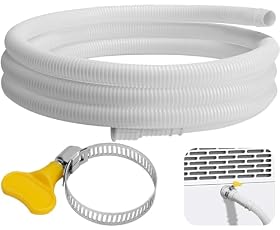
A unit with a bucket is convenient for occasional use but may stop when full. For a basement or other persistently damp space, continuous drainage is usually more practical.
One large dehumidifier may need:
A hose running continuously downhill to a floor drain or suitable drain point.
A condensate pump when the drain is higher than the dehumidifier.
A safe route that does not create a trip hazard or kink.
Two smaller units require the same planning twice. Before choosing them, confirm that each location has a safe drainage option or that you are willing to empty both buckets.
A drain hose must match the dehumidifier’s connection and be installed according to the manual. Keep the outlet secured and check for leaks after installation. Never route condensate where it can damage flooring, electrical equipment, foundations, or stored belongings.
Noise, heat, and placement
One larger machine may create a stronger single source of fan and compressor noise. Two smaller machines may sound quieter individually but create noise in two rooms and add their heat output to the home.
For living areas, bedrooms, or offices, look for manufacturer-published sound information when available and consider where the compressor will operate. For an unfinished basement, noise may matter less than drainage and airflow.
Leave the clearance specified in the manual around the intake and exhaust. Keep the unit level, away from standing water, and clear of dust, curtains, boxes, and other obstructions.
Reliability and maintenance
Two units provide some redundancy: one can keep working while the other is unavailable. But there are also twice as many filters, floats, buckets, fans, sensors, and compressors that may eventually need attention.
Whichever setup you choose:
Clean or replace filters on the schedule in the manual.
Keep grilles and coils free of dust.
Inspect hoses and pump connections for leaks.
Empty and clean buckets if you use bucket operation.
Check that the unit restarts correctly after a power interruption if that feature matters to you.
If a dehumidifier runs constantly without lowering humidity, look for water intrusion, condensation on cold surfaces, open windows, air leaks, or an undersized setup. More capacity will not correct an active plumbing leak, groundwater entry, or serious building-envelope problem.
Which setup should you choose?
Choose one 70-pint-class dehumidifier if you have a large, open, connected area and want the simplest installation and maintenance. It is usually the better starting point when one central unit can circulate air throughout the space.
Choose two smaller dehumidifiers if the damp space is divided into rooms, one area remains wet despite reasonable airflow, or you need separate control. Before buying, confirm that the combined capacity is appropriate, each unit can be drained safely, and the electrical service can support both machines.
If you are uncertain, measure relative humidity in each room for several days with inexpensive hygrometers. Similar readings suggest that one centrally placed unit may work. A consistently wetter closed room is evidence that it may need its own dehumidifier or better air circulation.
When neither option solves the problem
Persistent humidity above your target can indicate a larger moisture problem. Check for plumbing leaks, foundation seepage, poor grading, missing gutters, wet crawl spaces, unvented dryers, and excessive outdoor air entering through doors or windows.
If water is entering the building, repair the source before relying on dehumidifiers. For extensive seepage, electrical concerns, mold growth, or damage to the foundation, consult an appropriate qualified professional. Replace a dehumidifier when it has a failed compressor, refrigerant-system problem, unsafe cord or plug, repeated breaker trips, or repair costs that approach the cost of a suitable replacement.
Are two 35-pint dehumidifiers the same as one 70-pint dehumidifier?
Not necessarily. Their labeled capacities may add up to a similar number, but airflow, test conditions, room layout, temperature, and runtime affect actual moisture removal. Two units may work better in separate rooms and worse in one open area because they have less concentrated airflow.
Is one large dehumidifier more energy efficient than two small ones?
Often, but not always. Compare the current efficiency ratings and expected runtime under the same conditions. Two units may use more electricity when both run, but they can be more effective if one large unit cannot reach separated or closed-off rooms.
Can one dehumidifier dry an entire basement?
It can if the basement is sufficiently open and air can circulate between rooms. Closed rooms, blocked airflow, large moisture sources, and significant water intrusion can prevent one unit from controlling humidity throughout the basement.
Do two dehumidifiers need two separate circuits?
Not automatically, but the circuit must safely handle the combined electrical load and other appliances connected to it. Follow the manuals, avoid unsafe extension-cord or power-strip use, and consult a qualified electrician if breakers trip or the wiring is uncertain.
Should I buy two smaller dehumidifiers or one larger replacement?
Buy one larger unit when the space is open and simple drainage is important. Choose two smaller units when the moisture problem is divided among separate rooms or you need independent control. Compare current capacity and efficiency standards rather than relying on the number 70 alone.